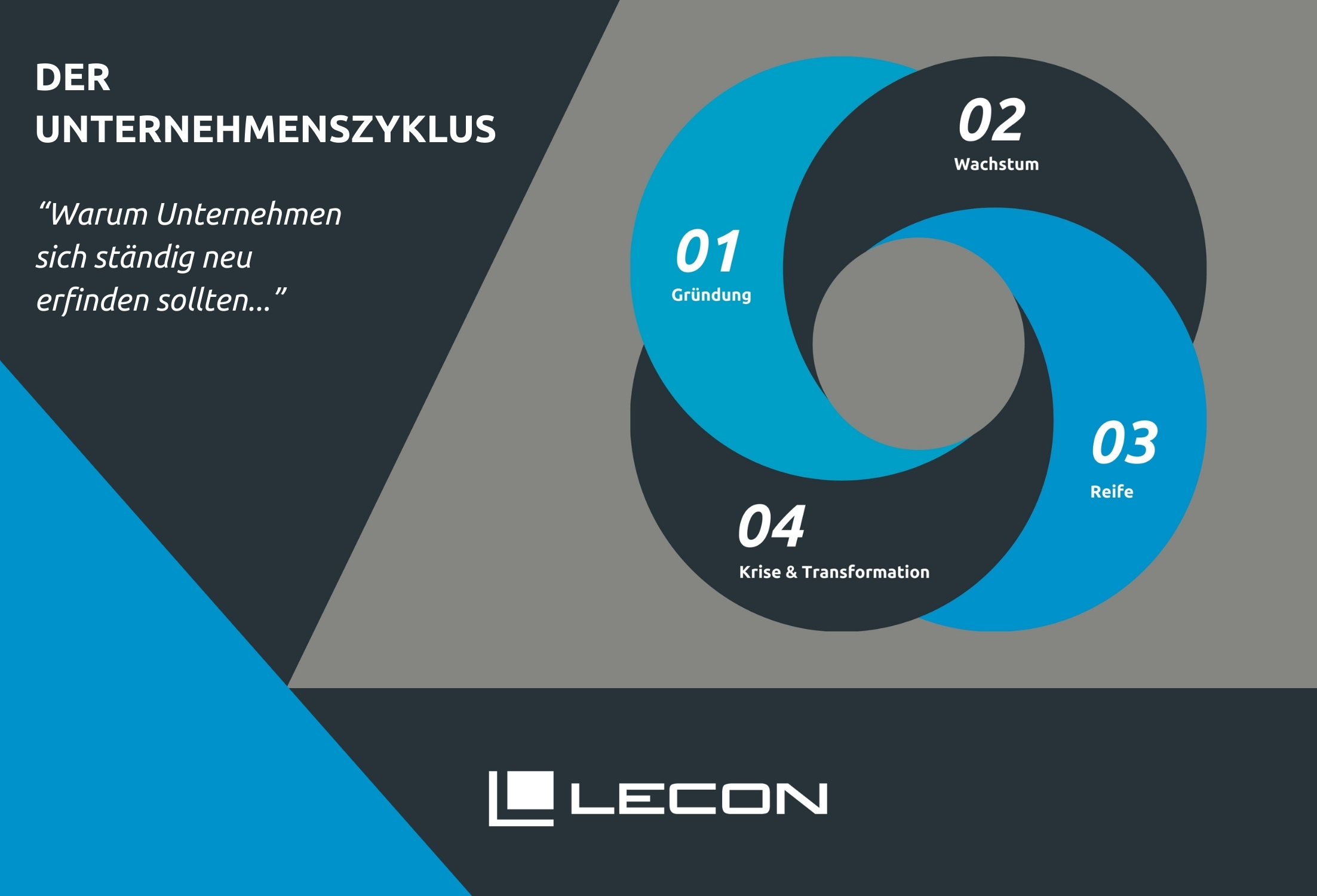
Companies do not simply come into being and then remain unchanged. They develop – often in clearly identifiable phases. Growth, stability, challenges and transformation are part of the natural life cycle of every company. Those who understand these dynamics can act strategically, seize opportunities and identify risks at an early stage.
As the economist Joseph A. Schumpeter so aptly put it:
“The process of creative destruction is the essential fact about capitalism.”
Companies emerge, change – and disappear. What matters is not whether something changes, but how early you respond to it.
The four phases of the business cycle
The classic business cycle consists of four phases: start-up, growth, maturity and crisis or transformation.
1. Start-up phase
In this phase, the company emerges from an idea. The aim is to build a working business model and to win the first customers.
Typical features are high uncertainty, limited resources and a need for financing. Many companies fail at this stage owing to a lack of capital or insufficient adaptation to the market.
2. Growth phase
Once the business model has proven itself, growth begins. The company wins more customers, increases revenue and hires new staff.
The focus is on expansion, scaling and building professional structures.
3. Maturity phase
The company has achieved a stable market position. Processes work efficiently, the brand is established and income is stable.
At the same time, there is a risk of low innovation, bureaucracy and declining adaptability.
4. Crisis or transformation
Changes in the market or in technology can lead to problems. Companies face two options:
- Crisis: falling revenue and possible loss of market share
- Transformation: adaptation through innovation, new business models or new markets
A successful transformation can start a new growth cycle.
Conclusion
The business cycle is not a one-off process, but repeats itself.
In the long term, successful companies are above all those that recognise change early and adapt.